IPDI Politics Online Conference

ipdi.jpg

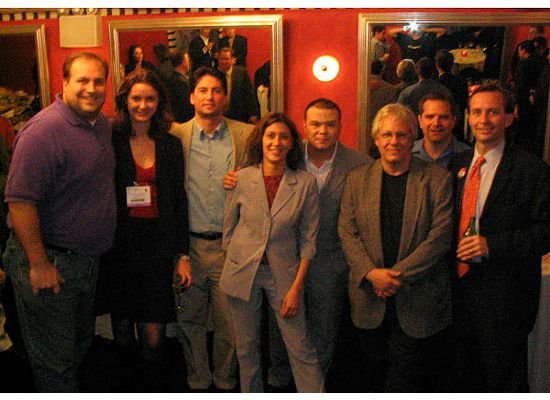
A bunch of us "grizzled new media veterans" (as John Durham put it) are down in Washington, DC today, speaking to political and cause-related marketers about the power and practical applications on online marketing and advertising. Among the attendees are myself, Durham, Scott Heiferman of Meetup and i-traffic fame, Kevin Lee of Did-it.com, Hugh McGoran from Knight-Ridder, Michael Zimbalist from the OPA, Adrienne Skinner from Yahoo and several others. Pictured above are Nick Nyhan from Dynamic Logic and Allie Savarino of Unicast.

One thing I've noticed about the folks in the political marketing arena is that they're running into many of the challenges we experienced in the consumer marketing space years ago as the Internet began to develop as a commercial medium. There is a significant educational process that needs to take place. Many attendees here are stuck in the "online advertising doesn't work" mindset that many folks in the consumer marketing space experienced after the dot com bubble burst. Others haven't the faintest idea of how to get started.

At the same time, great strides are being made in the grassroots application of online technology, especially community tools like blog applications, message boards and discussion lists. One unanswered question from the morning sessions is "How do we get a message out to the web community at large?" I plan to discuss this in great detail in my 2:30 session with Michael Zimbalist, Kevin Lee and John Durham.

One of My Favorite Interactive Stories

One of my favorite stories to tell about my experiences in the interactive medium is about Mark Cuban, current owner of the Dallas Mavericks and founder of AudioNet (later Broadcast.com). Mere days before the Yahoo acquisition was announced, Mark swung by the offices of K2 Design, where I was working at the time. My media department cronies and myself had asked him to come by and talk to the agency about ad opportunities in streaming media.

Mr. Cuban delivered an insightful and informative speech. After he left, I heard about the Yahoo transaction that made him a billionaire. The first though that occurred to me was "How was he able to contain himself? If I were about to become a billionaire, I'd be at home, making plans for my dream mansion."

So yesterday, I came across Mr. Cuban's blog and there was a contact form on the site. I submitted this letter to the site. Hopefully, he'll remember me and respond.

Dear Mr. Cuban:
I'm not sure if you remember me. The last time I saw you in person, you came to the offices of the little agency with which I was working at the time (K2 Design) and gave an intelligent and uplifting speech to us about Broadcast.com and the opportunities available in streaming media. This happened mere days before the Yahoo transaction was announced.
There's one thing I've always wondered about that day. Obviously, you had to know that you were about to become extremely rich. How did you manage to contain yourself? Personally, if I were you, I wouldn't have been able to get through the speech without bouncing off the walls. ;-)
Anyway, given the circumstances of the days following the presentation you gave, I never got the chance to thank you.
Thanks very much for an insightful presentation.
Best regards,
Tom Hespos

If he responds, I'll post the response here.

Coward or Hero?

zapatero.jpg

A lot of people are flipping this guy crap because he wants to pull Spanish troops out of Iraq. Few seem to be taking note that he wants to do it if and when June 30th rolls around and the U.N. hasn't taken military control of the situation. Most articles have concentrated on opinions circulating that Zapatero is giving in to the terrorists.

But is it "giving in to the terrorists" if...

  • 90 percent of the population of your country never wanted to go into Iraq in the first place?
  • An ally you trusted gave you inaccurate information as justification for invading Iraq?
  • You're tired of pretending that the ends (a Saddam-free Iraq) justify the means (invading under false pretenses)?

Furthermore, a lot of blogs I've been reading lately have given Zapatero flak because he has gone on record as saying that the occupation of Iraq "hasn't generated anything but more violence and hate." Some bloggers claim that since anti-war activists have been claiming that Iraq has nothing to do with the war on terror that using increased risk of terror attacks as justification for pulling out of Iraq is invalid.

I don't buy it. Remember that the Spanish went into the war with its leaders believing that Iraq did have ties to Al Qaeda. Osama bin Laden has been motivating terrorists by claiming that any western presence in the Middle East is an affront to Islam. I'm not saying this is a view that should be respected, but the following certainly holds true:

Spain may have judged the increased risk of terrorist attacks to be a justifiable one if indeed Saddam Hussein had ties to Al Qaeda. After all, that was one of the reasons given by Bush and Blair for invading in the first place. But when it was found out that Hussein didn't have such connections, the risk was taken for no good reason. Any responsible leader would realize that invading Iraq put his country at risk and that the reasons for doing so have completely changed, thus changing the value equation and making it necessary for a leader to reassess his country's commitment.

Attempt to justify the Iraq war all you want by saying that the "coalition of the willing" liberated the Iraqi people from a ruthless dictator. That was not the reason we were given for the invasion going into it. And any government that committed support to the invasion has a right to reassess those commitments in light of the fact that moral choices were made based on faulty information.