"I Got a Strong Mind That Doesn't Have to Be Spoon-Fed"

Bonus points to anyone who can name the 1991 rap song from which the title of this post was lifted.

In my Sunday morning cruise of the news shows, I saw two things that intrigued me. The first was a discussion about a video press release from the U.S. Department of Health and Human Services. Evidently, HHS put out a piece on Medicare using a hired TV reporter. The piece was edited to look like a news broadcast, and dozens of stations across the country ran all or most of the release as a legit news segment. Obviously, this irked some people.

Separately, the folks on "Fox and Friends" picked up on something we've been talking about in the online advertising industry for weeks - the defection of audiences from TV and newspapers. Surprisingly, not one of the commentators mentioned that people are flocking to the Internet. Not surprisingly, though, they talked a bit about the reasons why people are avoiding TV news and newspapers - a credibility gap.

Well, duh! When major news media fail to analyze what the administration spoon feeds them, obviously people are going to get upset and turn to other sources of news. Thankfully, the Internet is making it easier for private citizens to share thoughts with others. It's only natural that citizens turn to other citizens when news institutions go down the crapper.

The surge in popularity of blogs and independent online news sources is no coincidence. People are tired of the unprecedented cooperation between the major news media and the government. They want alternative points of view and critical thinking, not regurgitation of whatever the current administration thinks is important. We're seeing an online iteration of the "marketplace of ideas" concept, in which citizen-reporters and citizen-commentators are putting their thoughts out on the Internet in great numbers, and the cream is rising to the top.

Thanks to technology, publishing facts and commentary has never been easier. As more people publish their thoughts online, we see a process by which the best thinking, the most relevant agendas and the most credible facts come to light via a Darwinian process that involves small, independent online publishers putting forth an idea, larger online publishers developing it further, and online news aggregators disseminating it in a wider fashion. I think those that are involved in web publishing and the consumption of content from the Internet are all becoming better citizens of our democratic society for it.

Let Adam Smith's invisible hand do its job. If the mainstream broadcast and print news media want to continue sucking on the government's teat, let them do it. More people will defect to the Internet and will learn to engage in an active medium instead of being passively spoon-fed their news. The press release I linked to above condemns the government for their use of deceptive, TV-ready video news releases. How about condeming the media for lazily running this stuff instead of doing their jobs?


PowerBar Founder Dies of Heart Attack

homerbeer.jpg

Brian Maxwell, PowerBar founder and marathon runner, died Friday of a heart attack at the age of 51. I don't mean to disrespect the guy or his family, but this occurred only the day after Jimmy and I were taking a cigarette break on the fire escape at the office, discussing an episode of The Simpsons in which PowerBars were parodied. I recalled a quote:

Wake up, Homer! Those PowerSauce Bars are just junk! They're made of apple cores and Chinese newspapers!"

That's all I'm sayin'...

Torn

I ran into someone I haven't seen in a long time at the IPDI conference - Scott Heiferman, CEO of Meetup. I was doing the schmooze thing when Scott walked by and said hello. While we were getting caught up, he mentioned that he started up "a little trouble" in one of the morning panels. I missed the opening panel he was referring to because I was getting set up at our booth. When I asked Scott what happened, he kind of blew off the query, but I was curious, so I asked some of the other conference attendees what transpired.

Evidently, Scott made some anti-online advertising comments in the opening plenary panel. According to someone who was there, Scott picked up a sponsor's sign and said "This is not what it's about." The sponsor happened to be a company that was selling online commercials. This caused something of a stir.

I heard mixed comments about Scott's actions at that panel. Quite a few people praised him, saying that the grassroots approach - blogs, Meetup and other non-commercial messaging and discourse - represents the killer app for online political marketing. Others condemned Scott as a hypocrite, saying that the guy who made his living in the online agency business (i-traffic) shouldn't be condemning online advertising.

Lemme say this...Scott is a somewhat unorthodox guy, but he gets it. The guy is bringing a terrific application to the political marketing space. It's things like Meetup that give me hope for the future of democracy. (And no, I'm not being overly dramatic here. I'm serious.) Although I'm an online advertising guy, I do agree with Scott to some extent.

Shoveling TV commercials online is an overly simplistic approach and it doesn't leverage the most compelling capabilities of the medium. I would advise clients against this approach in most cases. Some make the argument that political advertisers need to base their understanding of the medium on something they already understand - like TV. Personally, I think this argument is somewhat of a cop-out.

But this isn't to say that online advertising isn't an important component of an online political marketing campaign. There's a lot more that can be done that doesn't involve shoehorning TV commercials into interactive :30 spots. I think that online advertising is a terrific way to deliver a focused message to the appropriate constituencies. Indeed, the panel I spoke on focused on how to get the right message to the right people.

At the panels I attended, there was tremendous focus on blogs and how to navigate the blogosphere such that political marketers can leverage that channel to get their message out. But one of the unanswered questions was, "How do we get the message out there in the first place?" I suggested that something like Google AdSense, which many bloggers incorporate into their sites to earn ad revenue, could help kill two birds with one stone. Not only can it help disseminate a message, but it can also support bloggers by giving them ad revenue in exchange for driving interested parties to campaigns and causes with a targeted message.

At our panel, we talked about quite a few other online advertising opportunities within the political space, including behavioral and contextual targeting plays, sites that can target geographically, paid search and others. These represent a terrific way for candidates and causes to disseminate a message in a targeted fashion.

So I disagree with Scott with regard to his notion of the usefulness (or lack thereof) of online advertising. But I do agree with him that cutting and pasting TV commercials into the online medium is not what it's all about. It's about an integrated, multi-channel approach in which each component supports the effort to the best abilities of the media utilized.

IPDI Politics Online Conference

ipdi.jpg

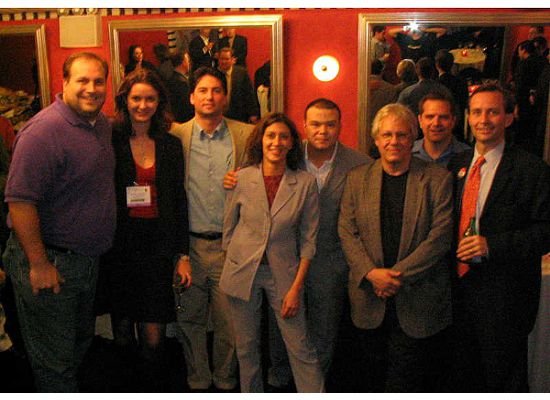
A bunch of us "grizzled new media veterans" (as John Durham put it) are down in Washington, DC today, speaking to political and cause-related marketers about the power and practical applications on online marketing and advertising. Among the attendees are myself, Durham, Scott Heiferman of Meetup and i-traffic fame, Kevin Lee of Did-it.com, Hugh McGoran from Knight-Ridder, Michael Zimbalist from the OPA, Adrienne Skinner from Yahoo and several others. Pictured above are Nick Nyhan from Dynamic Logic and Allie Savarino of Unicast.

One thing I've noticed about the folks in the political marketing arena is that they're running into many of the challenges we experienced in the consumer marketing space years ago as the Internet began to develop as a commercial medium. There is a significant educational process that needs to take place. Many attendees here are stuck in the "online advertising doesn't work" mindset that many folks in the consumer marketing space experienced after the dot com bubble burst. Others haven't the faintest idea of how to get started.

At the same time, great strides are being made in the grassroots application of online technology, especially community tools like blog applications, message boards and discussion lists. One unanswered question from the morning sessions is "How do we get a message out to the web community at large?" I plan to discuss this in great detail in my 2:30 session with Michael Zimbalist, Kevin Lee and John Durham.